The TASI closed at 10,930.05 on March 10, operating within a bear regime as 20-day momentum registered −6.88 and the market-wide average RSI sat at 38.46. Despite the bearish technical posture, breadth was firmly positive: 183 stocks advanced against 72 decliners with no names unchanged. Across the 22 tracked sectors, 18 posted gains while four retreated, suggesting broad underlying participation that contrasts with the prevailing regime classification. Nomu data was not available at publication.
Banks rose 2.51% with eight of ten constituents advancing and 20-day sector momentum of 6.48. Insurance led the market at +2.86%. Energy slipped 0.82% despite six of seven names finishing higher, as concentrated weakness in refining and petrochemical-linked names offset broader gains. Materials declined 1.38%, closing at 5,311.19; however, 37 of 43 names advanced, indicating that large-cap losses dominated the index-weighted outcome. The Materials sector carries a 30-day Brent correlation of −0.13, suggesting limited direct crude linkage. Utilities gained 1.51% with all seven constituents in the green.
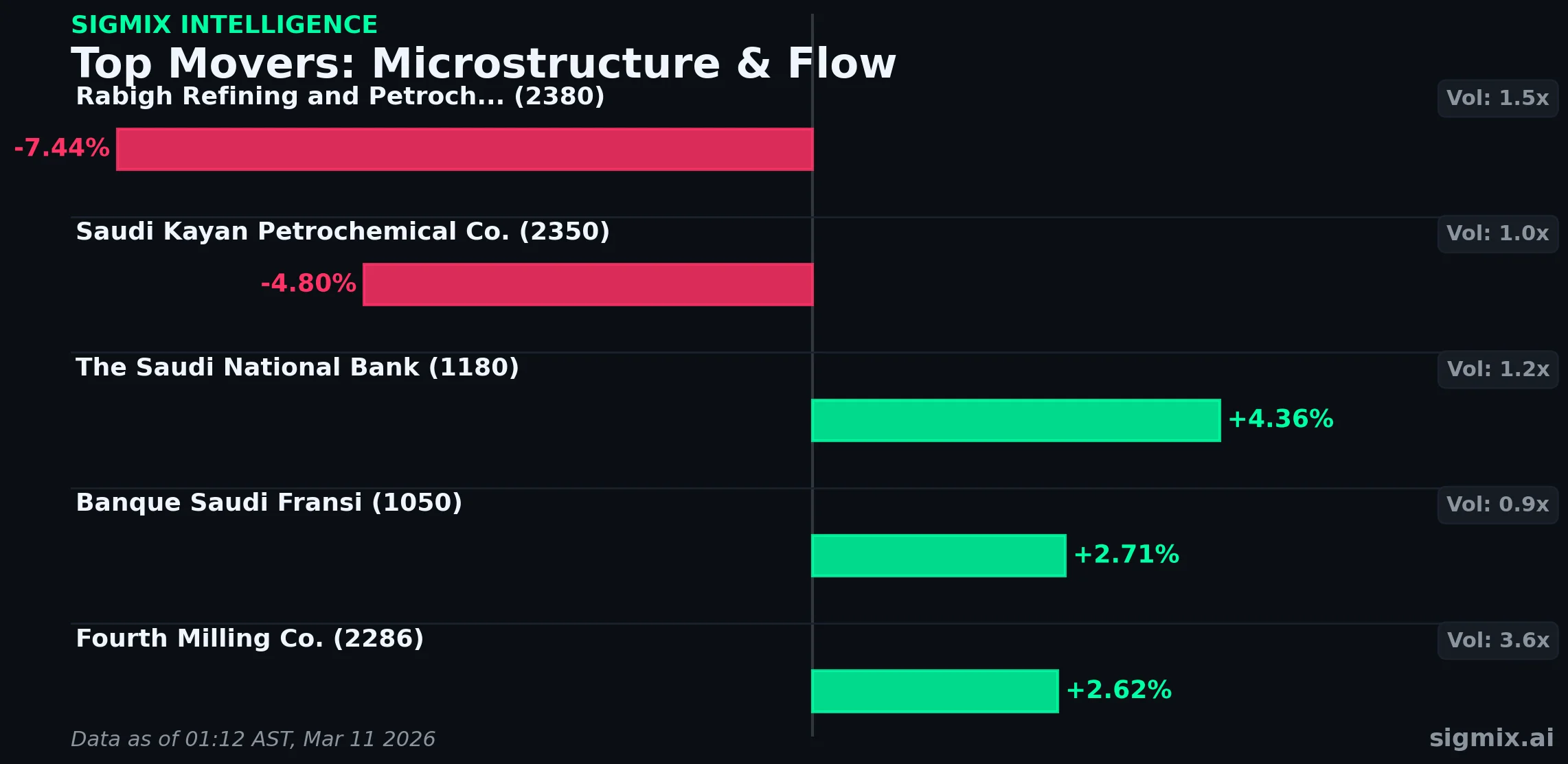
The Saudi National Bank (1180) climbed 4.36% to SAR 40.72 on volume of 7.24 million shares at 1.23x average volume. The bank trades at a trailing P/E of 9.97 and a 252-day beta of 1.12. The company holds a 95% historical earnings beat rate with 19 consecutive beats, though its most recent quarter was a miss. Microstructure data showed smart money flow active alongside buying pressure, seller exhaustion, and positive net order flow. Rabigh Refining and Petrochemical Co. (2380) tumbled 7.44% to SAR 8.71 on 8.66 million shares at 1.53x average volume. The refiner carries a negative trailing P/E of −2.55, reflecting ongoing losses. Institutional selling and selling pressure were both flagged, with volume-price divergence noted. Saudi Kayan Petrochemical Co. (2350) fell 4.80% to SAR 4.96 on 11.44 million shares at 0.95x average volume. With a trailing P/E of −3.93, the company remains loss-making. Institutional selling was active with negative net order flow and persistent selling pressure. Fourth Milling Co. (2286) advanced 2.62% to SAR 3.91 on 6.90 million shares—a notable 3.60x average volume. The stock trades at a trailing P/E of 10.62. Smart money flow was flagged alongside a large order ratio of 12.09x, suggesting sizable block participation.
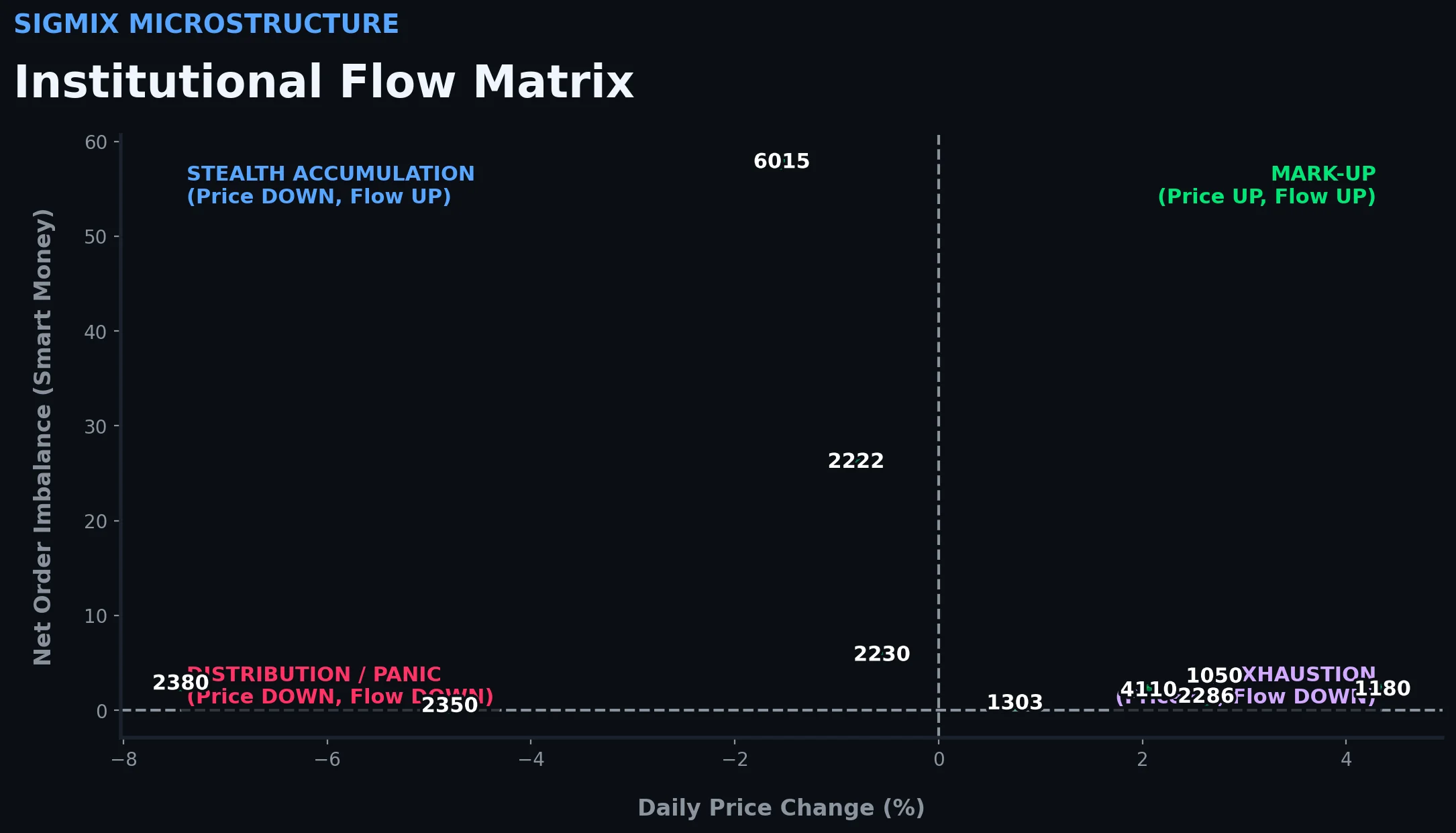
According to the Sigmix Microstructure Engine: Saudi Kayan (2350) registered net order flow of −43,691 shares with an order flow ratio of −0.41 and institutional selling active, indicating persistent outflows amid materials-sector weakness. Separately, The Saudi National Bank (1180) recorded net order flow of +3,661 with smart money flow detected and buying pressure confirmed at an order flow ratio of 0.37, consistent with the banking sector's broad advance.
Brent crude fell sharply, down 5.96% to $93.17, while gold firmed 0.83% to $5,182.41. The US equity regime remains neutral for 11 consecutive days. The SPY-TASI channel holds at normal status with 30-day correlation of 0.12 and a 7-day delta of +0.02. Both the XLE-Aramco and USO-Aramco channels are broken at correlations of −0.25 and −0.31 respectively, signaling Saudi energy names remain decoupled from US crude proxies.
January Industrial Production YoY data is scheduled for release today. On March 15, three key prints are due: February Inflation Rate YoY (previous: 1.8%), Inflation Rate MoM (previous: 0.2%), and Wholesale Prices YoY (previous: 2.9%).
What is not confirmed:
- Whether the bear regime persists given the strong 183-to-72 advance-decline divergence observed in today's session
- Whether Brent's 5.96% session decline will feed into broader energy-sector softness or whether the broken XLE-Aramco channel continues to insulate local names
- Whether smart money flow detected in banking names reflects sustained sector rotation or a single-session event
This report is produced by the Sigmix Intelligence Desk for informational purposes only. It does not constitute investment advice, a recommendation, or an offer to buy or sell any security. All data is derived from automated systems and may contain errors. Past performance is not indicative of future results. Readers should consult a licensed financial advisor before making investment decisions.