By product
Sovereign AI Workspace17 tools, one login · try free Sigmix OneFree on-device AI app · iPhone Sovereign AI ServersSealed on-prem appliance Sigmix Guard™Scrubbing & audit · optional PCIe card Sigmix ZeroSovereign Windows 11 endpoint StocksIQThe AI analyst for the Saudi market Sigmix GrowthPilotCross-platform CAC & budget AI Muraqaba AISeparate product · video AI Sigmix RedAI penetration testing · newBy industry
Banking & FinanceAligned to SAMA CSF · on-prem Public SectorAligned to NCA ECC-2:2024 · sealed HealthcarePDPL · sealed desktops EducationLighter, adaptive tone EnterpriseCustomer-facing suite · CRMSigmix Guard™
Our scrubbing & audit layer, running Sigmix-authored firmware — with an optional PCIe card for the appliance.
Explore Sigmix Guard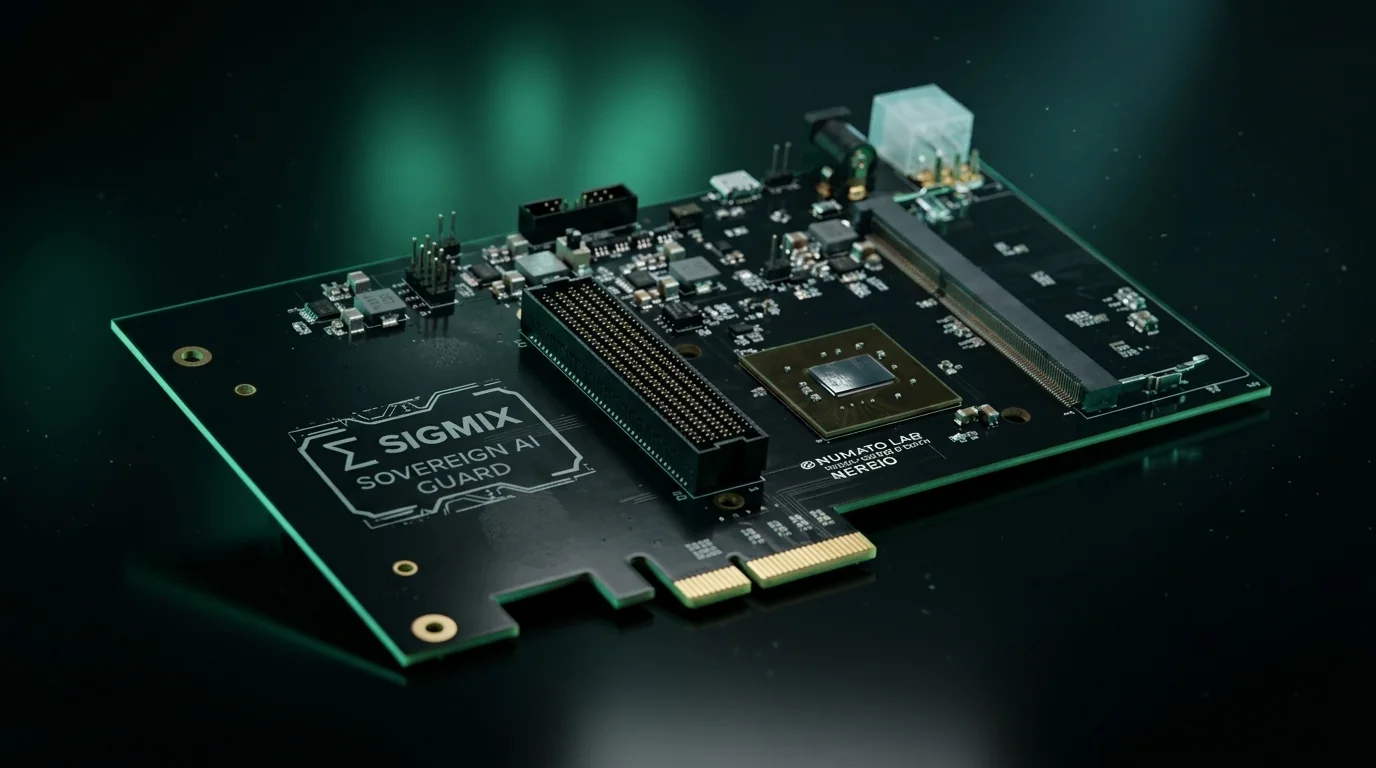
Sovereignty & compliance
Security postureAligned to NCA ECC-2:2024 · SAMA CSF · PDPL · ZATCA Zero-egress architectureDefault-deny · canary-monitored Sigmix Guard™Independent enforcement layer0 bytes egress — nothing leaves
Every request served on-box, sealed from the internet. KSA Cloud runs elastic and in-Kingdom.
See your postureA familiar API. An unfamiliar guarantee.
The Sigmix API follows the request and response shapes your team already writes against, so most integrations are a base-URL change. What differs is where the call lands — your own sealed appliance, or in-Kingdom cloud that never leaves Saudi Arabia.
// self-serve keys from the dashboard · same surface on every posture
# the only thing that changes between postures is the base URL
curl https://api.sigmix.ai/v1/chat/completions \
  -H "Authorization: Bearer $SIGMIX_API_KEY" \
  -H "Content-Type: application/json" \
  -d '{
    "model": "sigmix-chat-standard",
    "messages": [
      {"role": "user", "content": "لخّص هذا التقرير"}
    ]
  }'
Point it at the posture you bought.
One API surface across all deployments. Your code does not change when you move from a cloud trial to a sealed appliance — the base URL does, and that is the whole migration.
KSA Cloud
https://api.sigmix.ai/v1
Oracle in-Kingdom regions. Elastic, managed, nothing crossing the border.
On-prem appliance
https://sigmix.internal/v1
Resolves inside your own network. No outbound path exists to leave it.
Sigmix Zero
http://localhost:8443/v1
The device serves its own loopback endpoint. Works with the network unplugged.
Global Cloud
https://api.sigmix.ai/v1
The only tier reaching frontier models — and the only one that is not sovereign. Labelled everywhere.
Bearer keys, scoped and revocable.
Create keys yourself from the dashboard — no ticket, no sales call. Each key is scoped to a project, carries its own rate limit, and can be rotated or revoked without touching the others. Every call it makes is attributed to it in the audit log.
import os
from sigmix import Sigmix

client = Sigmix(
    api_key=os.environ["SIGMIX_API_KEY"],
    # swap this one line to move posture
    base_url="https://sigmix.internal/v1",
)

resp = client.chat.completions.create(
    model="sigmix-chat-standard",
    messages=[{"role": "user", "content": "Summarise Q3 revenue"}],
    stream=True,
)

for chunk in resp:
    print(chunk.choices[0].delta.content or "", end="")
Endpoints.
The core surface. Availability varies by posture — a sealed device reaches lower model tiers than a GPU rack, and the API reports what it can actually serve.
| Method | Path | What it does |
|---|---|---|
| POST | /v1/chat/completions | Chat and completion, streaming or buffered. Arabic and English. |
| POST | /v1/embeddings | Vector embeddings for your own retrieval pipelines. |
| POST | /v1/documents | Ingest a document into a knowledge base. Guard scrubs PII before indexing. |
| POST | /v1/documents/query | Retrieval-augmented query against an indexed knowledge base. |
| POST | /v1/images/generations | Image generation, where the posture has the compute for it. |
| POST | /v1/audio/transcriptions | Speech to text, Arabic and English. |
| GET | /v1/models | What this deployment can actually serve — not a global catalogue. |
| GET | /v1/audit/anchors | Retrieve TPM-signed audit anchors for independent verification. |
| GET | /v1/health | Liveness, model readiness and — on sealed postures — the egress counter. |
// full reference, schemas and error codes live in the developer docs — link from your dashboard once you have a key
The sovereign parts.
Verifiable audit anchors
Every call is hashed into a chained anchor and TPM-signed. Pull them from /v1/audit/anchors and verify them yourself, off-box.
Scrubbing on the request path
National ID, Iqama, IBAN and card patterns are redacted before the model sees them — including through the API, not just the app.
Residency in the response
Every response carries the region it was served from. Your own logs can prove residency without taking our word for it.
Honest model listing
/v1/models returns what this deployment can serve. A sealed device will not advertise a frontier model it cannot run.
No training on your calls
API traffic is never used to train any model. On sealed postures the question is moot — nothing leaves to be trained on.
Portable by design
No proprietary lock-in in the wire format. If you outgrow us, your integration is a base URL away from something else.
Use ours, or the one you already have.
Because the surface is compatible, most existing clients work by pointing them at a Sigmix base URL. We also ship first-party SDKs where it saves you the boilerplate.
Bounded by your plan, or by your hardware.
On the cloud, limits are per key and per plan. On an appliance you own the compute, so the only ceiling is the box — we do not meter what is already yours.
Retry-After.For developers
How compatible is "compatible"?
Do I need a different key per posture?
Does the API work with no internet?
Which models can I request?
/v1/models against the deployment you are pointed at. It returns what that box or region can actually serve rather than a global catalogue, so you never get a runtime failure from requesting something the hardware cannot run.Is API traffic used for training?
How do I verify an audit anchor?
/v1/audit/anchors, check the chain, and verify the TPM signature against the appliance's public key. The specification is in the evidence pack — see the Trust Center.Get a key and make one call.
Start on the KSA Cloud during the trial, write your integration against it, then repoint the base URL when your appliance is racked. Same code, different building.