By product
Sovereign AI Workspace17 tools, one login · try free Sigmix OneFree on-device AI app · iPhone Sovereign AI ServersSealed on-prem appliance Sigmix Guard™Scrubbing & audit · optional PCIe card Sigmix ZeroSovereign Windows 11 endpoint StocksIQThe AI analyst for the Saudi market Sigmix GrowthPilotCross-platform CAC & budget AI Muraqaba AISeparate product · video AI Sigmix RedAI penetration testing · newBy industry
Banking & FinanceAligned to SAMA CSF · on-prem Public SectorAligned to NCA ECC-2:2024 · sealed HealthcarePDPL · sealed desktops EducationLighter, adaptive tone EnterpriseCustomer-facing suite · CRMSigmix Guard™
Our scrubbing & audit layer, running Sigmix-authored firmware — with an optional PCIe card for the appliance.
Explore Sigmix Guard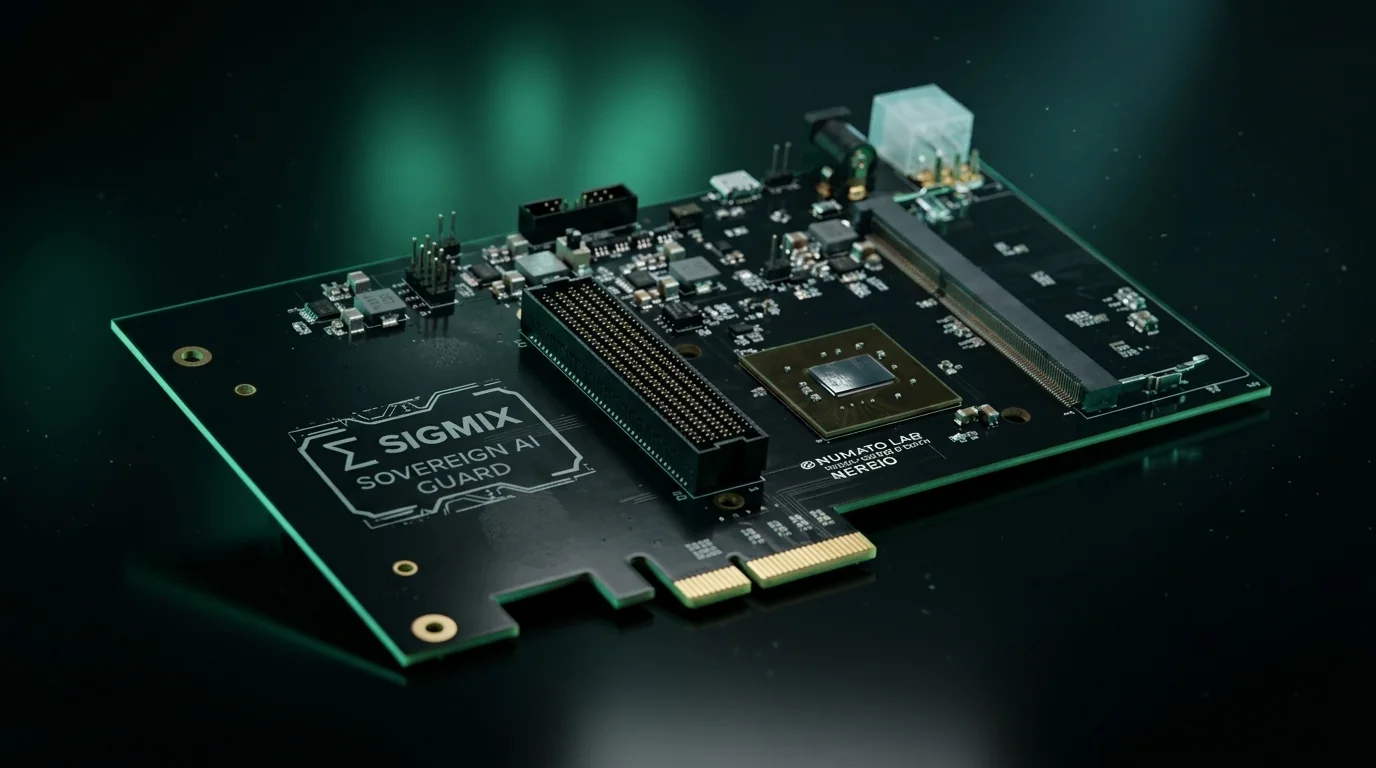
Sovereignty & compliance
Security postureAligned to NCA ECC-2:2024 · SAMA CSF · PDPL · ZATCA Zero-egress architectureDefault-deny · canary-monitored Sigmix Guard™Independent enforcement layer0 bytes egress — nothing leaves
Every request served on-box, sealed from the internet. KSA Cloud runs elastic and in-Kingdom.
See your posture
Patient data that never leaves the building.
Clinical notes are the most sensitive free text a hospital holds — and exactly the material staff most want help with. Sigmix resolves that tension architecturally: the model runs on your hardware, so the notes never go anywhere to be helped with.
Staff are already using AI. The question is where.
Ask honestly and most hospitals find clinicians and administrators already pasting work into consumer AI tools on personal accounts — because the job is hard and the tool helps. That is the real data-protection exposure, and a policy banning it has not closed it anywhere.
A ban moves the risk. It doesn't remove it.
The instinct is to prohibit AI on clinical material. In practice that pushes usage onto personal devices and accounts you cannot see, audit or govern — and the sensitive text still leaves the building, just without a record of it.
Giving staff a sanctioned tool that runs inside the hospital removes the reason to go elsewhere. The work gets done, the data stays put, and for the first time there is an audit trail of what was asked and by whom.
Notes pasted into consumer AI on personal accounts. No audit trail, no residency control, and no way to evidence any of it to a regulator.
Models run on hospital hardware. PII scrubbed on the request path, every request audit-anchored, nothing transmitted anywhere.
Documentation, not diagnosis.
Sigmix is a documentation and administration tool. It drafts, summarises, translates and answers questions across material you already hold. It does not diagnose, triage or make clinical decisions, and we would rather be clear about that than sell into a claim we cannot stand behind.
Clinical judgement stays entirely with the clinician. Anything the system produces is a draft for a person to review, correct and own.
 On-device · nothing transmitted
Documentation support
Tidying notes, drafting letters and discharge summaries, restructuring dictated text — on the device, reviewed by the clinician.
Protocol & policy lookup
Ask questions across your own clinical guidance and internal policy, in Arabic or English, with the source attached.
Administrative load
Rosters, correspondence, procurement documents and reporting for the non-clinical teams who carry most of the paperwork.
Bilingual by default
Arabic-native output for a workforce that documents in both languages, with full right-to-left throughout.
Identifiers scrubbed first
National ID, Iqama, MRN-style patterns and contact details redacted on the request path — before the model, not after the fact.
Audit trail for the regulator
Every request hashed into a tamper-evident anchor and exportable to your SIEM — the evidence a PDPL review asks for.
Sealed desks first, then the department.
The common starting point is Sigmix Zero on the desks handling the most sensitive material — medical records, HR, legal, the executive floor. The models run on the machine, so the question of transmission never arises.
Where a whole department needs shared capacity, an on-prem appliance serves the building with the same posture — sealed, zero-egress, nothing leaving the site.
 Records & administration


What you can evidence.
PDPL asks you to demonstrate control, not to promise it. These are the artefacts the platform produces for that conversation.
Control mapping
Mapping against PDPL and NCA ECC-2:2024, released under NDA in the evidence pack. Trust Center →
Retention & erasure
Retention limits and right-to-erasure via crypto-shredding, configurable to your own records policy.
Identity & access
Active Directory or SSO, with capability gates set centrally and every change recorded.
For clinical governance, IT and procurement
Is this a medical device?
Where do patient notes go?
How does it handle identifiers?
Can we prove to a regulator what happened?
Does it integrate with our HIS or EMR?
What about Arabic clinical language?

Bring your DPO to the first call.
The useful conversation is about scope and evidence — what staff would actually use it for, which identifiers get scrubbed, and where the audit trail lands. Bring the person who will have to answer for it under PDPL.